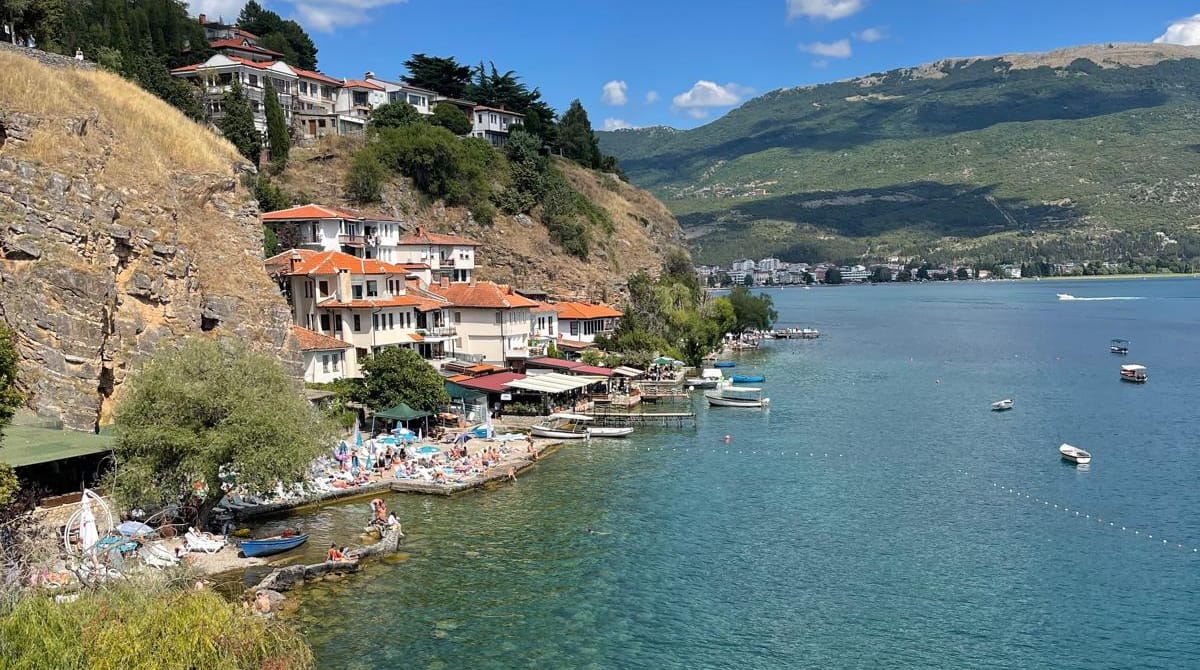
Lake Ohrid
Over a million years old, up to 288 metres deep and so clear you can see the stones far below — and five minutes’ walk from our door.
Lake Ohrid is the reason the town exists, and the reason most people come. It is among the oldest lakes in the world, and because it has been isolated for so long, it is home to plants and animals found nowhere else.
Lake Ohrid in numbers
| Age | Over one million years — estimates range up to around five million |
|---|---|
| Depth | 288 m at its deepest, 155 m on average |
| Surface | 358 km² — about two thirds in North Macedonia, one third in Albania |
| Fed by | Springs and small rivers, and an underground link with Lake Prespa on the other side of the Galičica mountain |
| Flows out | At Struga, as the river Black Drin |
| UNESCO | World Heritage since 1979 for its nature and 1980 for its culture; the Albanian part was added in 2019 |
Can you swim in Lake Ohrid?
Yes — and you should. The swimming season runs from June to September, when the water warms to around 20–24 °C. In late May and October it is bracing but possible on a sunny day.
All the beaches are pebble or stone rather than sand, so water shoes make life easier. The water is clear and drops off quickly in places; children should stay close to the shore.
From us, the nearest place to swim is Saraište, a small pebble beach just past the harbour — about 10 minutes on foot.
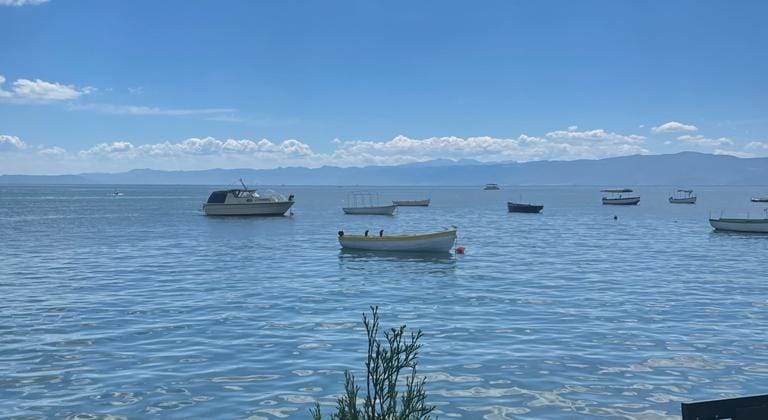
Beaches around Ohrid
Below the old town
Small stone beaches and bathing platforms between the harbour and Kaneo — the closest swim from the old town, lively in summer.
Saraište is the closest, about 10 minutes on foot from us.
Kaneo
The little beach below the church of St. John at Kaneo, with sun loungers and a floating pontoon. Small and popular — come early.
About 20 minutes on foot. Small and popular in July and August — come early.
Gradište & Lagadin
Longer pebble beaches on the eastern shore towards St. Naum, with sunbeds and beach bars.
A short drive south of Ohrid, along the road to St. Naum.
Labino
Small pebbly coves in the shade of tall trees, below the paths near Kaneo — quieter than the beaches in town.
Around 20 minutes on foot, along the paths towards Kaneo.
Boats, monasteries and a village on stilts
Boats from the harbour
Small boats run from the harbour to Kaneo and along the shore, or simply out onto the water at sunset. Agree on the price before you set off.
The harbour is about 5 minutes on foot. Prices depend on the boat and the length of the trip — ask a few captains before you choose.
St. Naum
The monastery at the southern end of the lake, where springs fed partly from Lake Prespa rise. A rowing boat takes you across them.
About 30 km south of Ohrid. By car it is the easiest; in summer, boats also go there from the harbour.
Bay of Bones
A reconstructed pile-dwelling village from around 1200–700 BC, standing on stilts in the water near Peštani, about 16 km south of Ohrid.
Entrance is around 150 denars; in summer roughly 9:00–19:00, shorter off-season.
Ohrid trout and Ohrid pearls
Of the many species found only here, the best known is the Ohrid trout. A few decades ago it had become rare; since 2005 it has been protected, and it is slowly coming back. Biologists have found its eggs in the spawning grounds again for the first time in years.
The famous Ohrid pearls are not from oysters: they are made by hand, using a coating from the scales of a small fish from the lake. Only two families still make them, Filevi and Talevi, and both have shops in Ohrid.
Lake Ohrid — quick answers
How warm does Lake Ohrid get?
Around 20–24 °C at the surface in July and August, a little cooler in June and September.
Is Lake Ohrid clean?
It is one of the clearest lakes in Europe.
Is Lake Ohrid in Albania too?
Yes — about one third of the lake belongs to Albania, with the town of Pogradec on its southern shore.
How deep is Lake Ohrid?
288 metres at its deepest point, which makes it one of the deepest lakes in Europe.